Case study · · 4 min read
Modella – AI Virtual Try-On Platform Case Study
Modella is a production-grade AI virtual try-on platform that lets users upload photos and generate realistic outfit visualizations in seconds. I designed and engineered the entire system — from FLUX-based GPU pipelines and backend orchestration to the Vue/Nuxt frontend and cloud deployment.

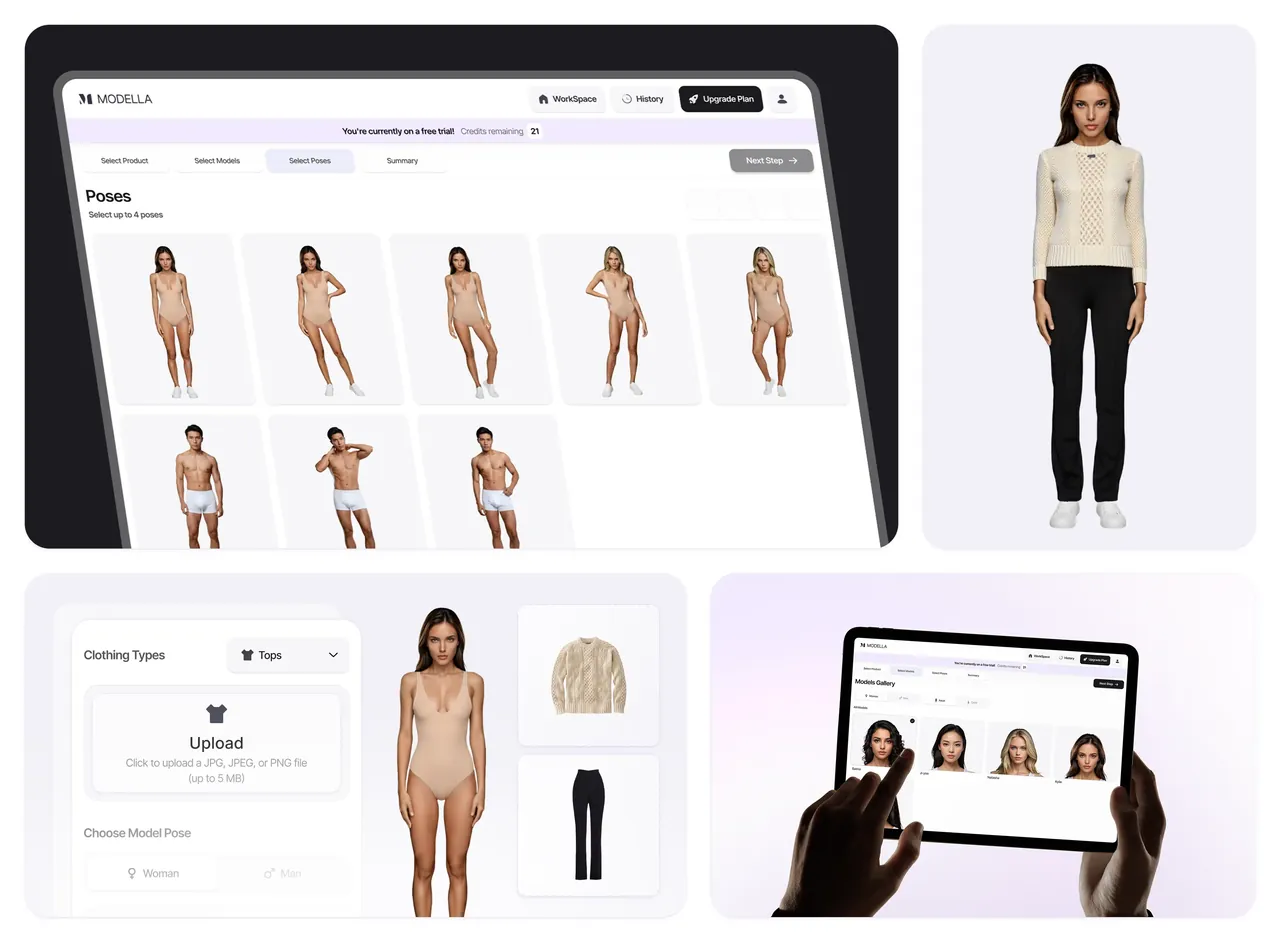
Built for real users and real traffic, Modella is not a research demo — it's a fully operational platform ready for scale, integrations, and commercial use.
Product & Goals
The founder’s vision required going beyond typical AI demos. The goal was to build a real try-on experience — reliable, scalable, and fast enough to impact user conversion and shopping behavior.
The platform needed to:
- Accept diverse user photos (different poses, lighting conditions, outfits).
- Generate highly realistic try-on results with minimal artifacts.
- Work under traffic spikes from marketing campaigns.
- Be platform-ready for white-labeling, new brands, and integrations.
Before development, we ran a feasibility and product alignment phase: defining performance targets, UX constraints, expected daily volume, and a roadmap for advanced features like outfit recommendations and analytics.
Architecture Overview
Modella’s architecture follows a modular, scalable design — enabling fast iteration while ensuring production reliability. The system is composed of several dedicated services:
- Frontend: Vue/Nuxt SPA with optimized upload flow, galleries, and generation progress tracking.
- API Gateway: central backend validating requests, routing jobs, and managing sessions.
- GPU Workers: FLUX inference services running on cloud GPUs with queue-based load balancing.
- Task Queue: Redis-backed queue layer for decoupling user requests from GPU workloads.
- Storage: object storage for input images, intermediate artifacts, and final outputs.
- Monitoring: observability stack tracking latency, errors and GPU utilization.
This architecture lets the platform start lean, operate cost-efficiently, and scale horizontally without rewrites.
FLUX Pipeline & Image Processing
The Modella try-on experience is powered by a multi-stage image pipeline built around Stable Diffusion FLUX and supporting CV components. To the user, it's simple: upload → wait → see outfit. Behind the scenes, it's a structured, observable pipeline:
- Preprocessing: normalize images, detect person, extract pose, segment garment regions.
- Conditioning: prepare prompts and control signals tailored to pose and clothing type.
- Inference: optimized FLUX runs with tuned quality-speed configs and batching where relevant.
- Post-processing: refine edges, adjust lighting, remove artifacts, compress for web delivery.
The pipeline supports model versioning, fast iteration, and controlled upgrades — enabling continuous improvement without breaking UX.
Scaling, Performance & Reliability
AI image generation is expensive. Modella uses a performance-first architecture to keep latency predictable and costs manageable:
- Queue-first workflow: all jobs are queued to absorb bursts and protect GPUs.
- GPU autoscaling: horizontal scaling based on queue depth & latency targets.
- Retries & timeouts: strict stage limits with controlled fallback behavior.
- Caching: reuse intermediate data where possible to reduce GPU load.
These choices allow Modella to handle peak traffic while maintaining a consistent generation experience.
User Experience & Product Layer
For consumer-facing AI products, UX quality determines adoption. We built the interface with clarity and confidence in mind:
- Guided upload flow with visual instructions for best results.
- Optimistic UI and real-time progress steps during generation.
- Comparison tools: before/after view, multi-look grids.
- Platform-ready layout for branding, partners, and future extensions.
The end result feels like a polished consumer product — even though it's powered by complex AI under the hood.
Outcomes
Modella launched as a real, production-ready AI platform — not a prototype. Key results:
- Stable FLUX pipeline ready for rapid iteration and style expansions.
- Cloud architecture prepared for commercial scaling and future B2B integrations.
- Fast, intuitive UX proven through live user sessions.
- Foundation for upcoming features like recommendations and AI styling assistants.
Tech Summary
- AI & CV: Stable Diffusion FLUX, pose detection, segmentation, custom conditioning.
- Backend: orchestration layer, Redis queues, observability & logging.
- Infrastructure: cloud GPUs, autoscaling, performance metrics.
- Frontend: Vue/Nuxt SPA with upload flow, galleries & comparison UI.
Thinking about your own AI platform?
I'm Ian Koncevich, an AI Product Architect helping founders build scalable AI SaaS platforms — from architecture and data flows to UX and production deployment.
If you're planning an AI product — virtual try-on, multi-agent system, AI tooling, or data-first SaaS — and want it engineered properly from the start, feel free to reach out.
Message me on LinkedIn or via iankoncevich.com/contact.